

Information
The Pros and Cons of Distance Running, Hill Runs, Weighted Training and Sprints


Running is one of the most popular forms of exercise in the UK, whether that’s joining a Saturday Parkrun, tackling the London Marathon, or training on trails in the Lake District. But running isn’t a one-size-fits-all activity.
Some prefer steady long-distance runs, others swear by hill sprints for explosive power. More advanced runners experiment with weighted vests, while sprinters focus on short bursts of maximum speed. Each method offers unique gains—but also comes with risks.
In this article, we’ll explore the pros and cons of distance running, hill runs, weighted training, and sprints, with expert-backed insights, UK-friendly advice, and a simple comparison table. By the end, you’ll know how to choose the right approach for your goals.
Distance Running
What It Is
Distance running is steady running over longer periods, usually anything from 5km to a full marathon. It’s the most common form of running in the UK, with thousands participating in Parkruns and big events like the Great North Run.
Pros
- Builds stamina and endurance – Distance running strengthens the heart and lungs, improving aerobic capacity (VO₂ max).
- Supports mental health – Long runs release endorphins, reduce stress, and improve mood. Many runners describe the “runner’s high”.
- Steady calorie burn – Excellent for fat loss and long-term weight management.
- Accessible to beginners – You don’t need special equipment, just a good pair of shoes.
Cons
- Risk of overuse injuries – Common issues include shin splints, stress fractures, and knee pain (running injuries).
- Time-consuming – Training for a half or full marathon requires hours each week.
- Not ideal for speed or muscle growth – Distance running improves endurance but not explosive strength.
Best For
Those who want endurance, mental resilience, and long-term calorie burn. Perfect for anyone training for a race or just enjoying longer sessions outdoors.
Hill Runs / Uphill Running
What It Is
Hill running involves tackling slopes, whether long steady climbs or short explosive hill sprints. It’s popular in UK regions like the Peak District or Scottish Highlands.
Pros
- Strength and power gains – Running uphill activates the quads, calves, hamstrings, and glutes, almost like weight training.
- Improves running form – Hills naturally encourage better posture and stride mechanics.
- Lower impact on joints – Running uphill is easier on the knees than pounding downhill.
- Boosts speed – Hill sprints improve your sprinting ability on flat ground.
Cons
- Very demanding – Hill sessions are tough on the cardiovascular system and muscles.
- Risk of muscle strain – Calves and hamstrings can be overloaded if intensity ramps up too quickly.
- Not always accessible – If you live in a flat area, you may need a treadmill with incline.
Best For
Runners looking to build leg strength, speed, and efficiency. Hill runs are especially useful for those training for trail races or cross-country events.
Weighted Running
What It Is
Weighted running involves wearing a weighted vest or light backpack. Some try ankle weights, but experts generally advise against them due to joint strain.
Pros
- Increases calorie burn – Extra weight makes your body work harder.
- Improves running economy – Over time, running without the vest feels easier.
- Strengthens muscles and posture – A snug vest can improve core stability and form.
- Simulates racing conditions – Trail and military runners often train with packs to mimic real conditions.
Cons
- Joint and injury risks – Carrying too much weight stresses the knees, hips, and ankles.
- Form breakdown – If the vest is too heavy (over 10% of body weight), running mechanics suffer.
- Not beginner-friendly – Weighted running should only be added once a strong base is built.
Best For
Advanced runners seeking an extra challenge or crossover strength-endurance training. Beginners should avoid it until they have solid technique and mileage.
Sprinting (Flat Running)
What It Is
Sprinting is running short bursts at near-maximum speed, often on a track, field, or treadmill. Sessions are usually structured as intervals (e.g., 10 × 100m).
Pros
- Explosive speed and strength – Sprints activate fast-twitch muscle fibres essential for power sports (muscle fibre types).
- Efficient calorie burn – High-intensity sessions burn fat quickly and raise metabolism post-workout (the “afterburn effect”).
- Boosts VO₂ max – Improves oxygen efficiency for both sprinters and endurance athletes.
- Time-efficient – Great for those with limited training time.
Cons
- Higher injury risk – Hamstring and calf pulls are common if not warmed up properly.
- Recovery time needed – You can’t sprint hard every day without risking burnout.
- Not ideal for endurance – Builds power, not long-lasting stamina.
Best For
Athletes who want explosive power, fat loss, and speed. Excellent as part of a HIIT routine.
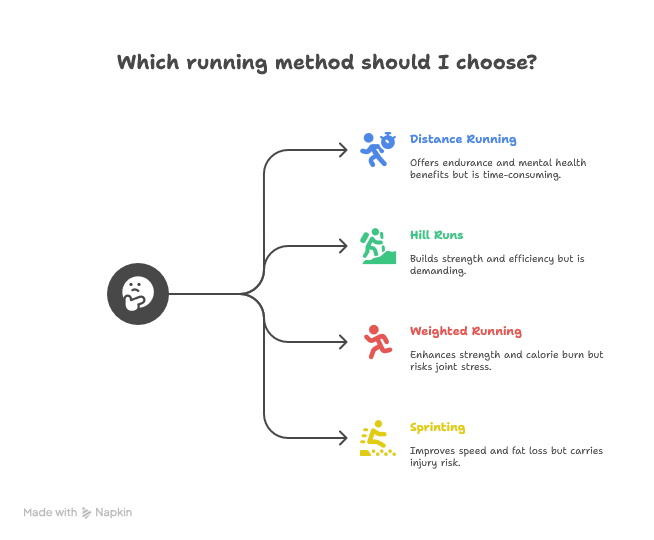
Comparison Table
Here’s a quick reference to compare all four methods:
| Running Type | Key Benefits | Main Drawbacks | Best For |
|---|---|---|---|
| Distance Running | Endurance, mental health, calorie burn | Time-consuming, overuse injuries | Races, long fitness sessions |
| Hill Runs | Strength, speed, running efficiency | Demanding, risk of strains | Trail and cross-country runners |
| Weighted Running | Strength, posture, calorie burn | Joint stress, poor form if too heavy | Advanced runners |
| Sprinting | Speed, explosive power, fat loss | Injury risk, high recovery demands | Athletes, HIIT training |
How to Combine Them Smartly
A well-rounded training plan doesn’t rely on just one method. Instead, it blends these approaches:
- Use distance runs 2–3 times per week to build an aerobic base.
- Add hill sprints once per week for strength and speed.
- Sprinkle in flat sprints or intervals for fat loss and explosive power.
- Include weighted runs sparingly (1× per week max), keeping the vest at 5–10% of body weight.
Example for a UK runner:
- Tue – 5K distance run (steady pace).
- Thu – 8 × 10s hill sprints.
- Sat – Parkrun (fast 5K or intervals).
- Sun – Easy long run with a light vest.
Safety & Injury Prevention
- Warm up and cool down properly, especially before sprinting.
- Progress gradually – increase weekly mileage by no more than 10%.
- Invest in shoes suited to terrain (road, trail, track).
- Cross-train (cycling, swimming, strength training) to reduce repetitive strain.
- Listen to your body – aches are signals, not badges of honour.

Case Study: Thai Boxers Running in Thailand – “No Run, No Muay Thai”
In Thailand, Muay Thai boxers often begin their day before dawn with a group run through the streets or rural paths—regardless of distance, hills, or intensity. This ritual is more than just training; it’s ingrained in their identity.
Conclusion
Each type of running has its place:
- Distance running builds stamina and mental resilience.
- Hill runs create strength and running efficiency.
- Weighted running adds resistance for advanced runners.
- Sprinting develops speed and explosive power.
The best approach is not choosing one over the other, but blending them smartly into your routine. Train with purpose, progress gradually, and you’ll unlock a stronger, faster, and healthier version of yourself.